

Residential construction and ADUs in Orange County
Room additions, ADUs, garage conversions, and whole-home renovations. Licensed California contractor. We handle permits, inspections, and finish work from demo to final walkthrough.
What we build
ADUs, additions, and larger residential scopes
Beyond kitchens and baths, CRS Construction takes on room additions, garage conversions, ADUs, and whole-home renovations that need a licensed general contractor to coordinate structure, mechanicals, and finishes.
We work from Fountain Valley across Orange County, filing permits when the city requires them, scheduling inspections, and keeping you updated when scope or lead times change.
California state law has made it easier to add an ADU or junior ADU (JADU) to most single-family lots, with many cities required to process compliant applications on a streamlined timeline. Actual size limits, setback requirements, parking rules, and utility connection requirements still vary by city, so we confirm your lot's specific zoning and code requirements before finalizing a design rather than assuming a one-size-fits-all layout.
Larger scopes also mean more moving parts before a shovel goes in the ground: soils and structural questions, utility capacity, HOA approval where it applies, and a realistic sequence for framing, mechanicals, and finishes. We work through that planning with you up front so the written scope reflects the actual site conditions, not a generic template.
For many Orange County homeowners, an ADU is as much an investment as a construction project. Sometimes called a secondary suite, a permitted accessory dwelling unit adds independent living space that can generate rental income and add measurable property value, whether you build a detached ADU, convert an existing garage, or attach a new dwelling to the main house. As an experienced Orange County ADU builder, we plan the layout, utilities, and finishes with that return in mind, and our ADU cost guide breaks down what different unit types typically run so you can weigh the numbers before committing to a design.
ADU projects
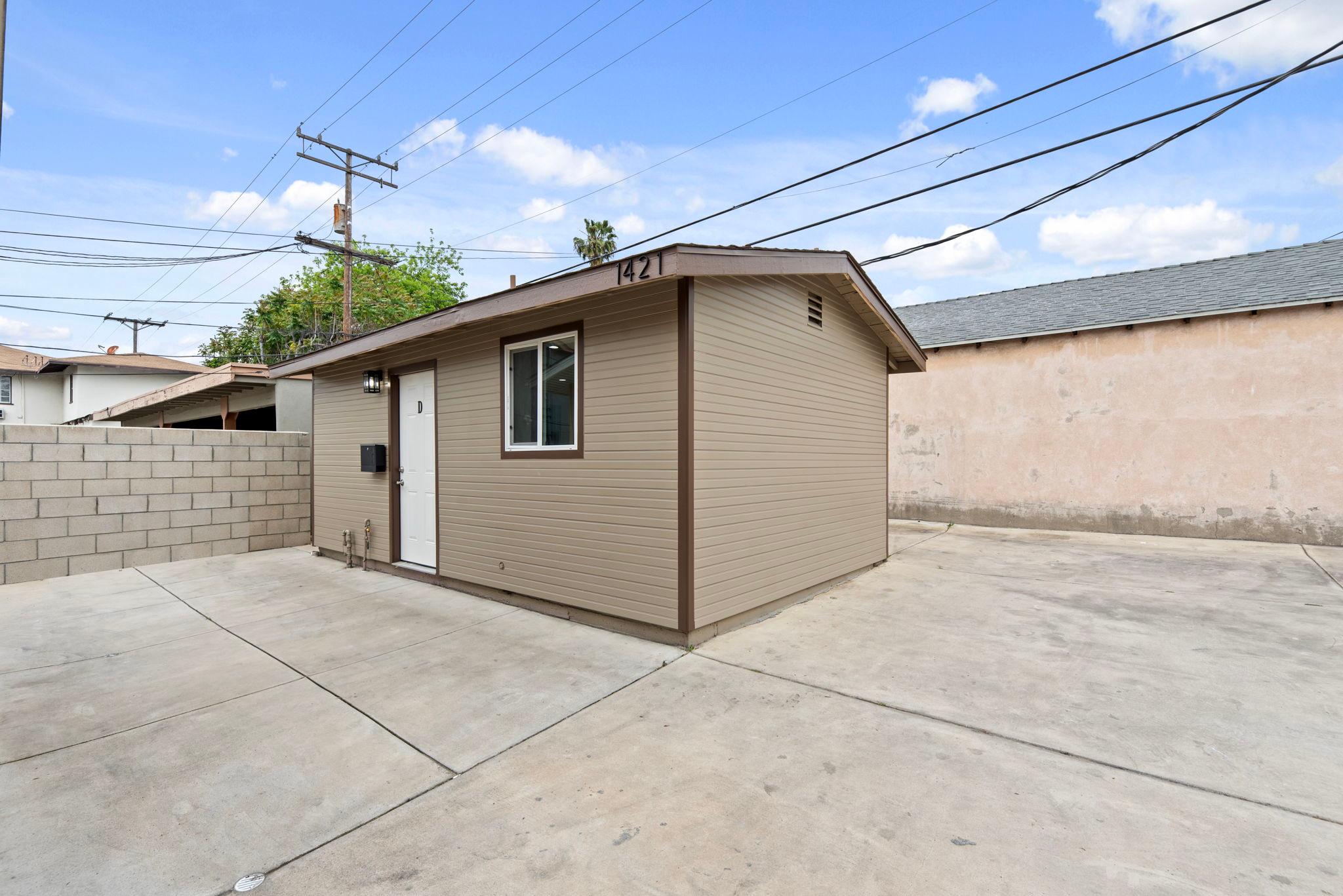
A detached one-car garage converted into a fully permitted studio ADU, built specifically for rental use. CRS Construction stripped the structure down to the studs and rebuilt it from the ground up, adding new insulation, a dedicated electrical panel, and the plumbing needed for a kitchen and bathroom that didn't exist in the original garage. The finished unit includes a quartz-and-subway-tile kitchenette with a gas range, over-range microwave, and full-size refrigerator, a glass-enclosed shower bathroom, and in-unit laundry. Luxury vinyl plank flooring, recessed lighting, and a ductless mini-split for heating and cooling run throughout. Completed in two to three months, the unit is fully permitted and move-in ready under its own address.
Photos
How do you hire an ADU builder in Orange County?
Hire a licensed general contractor who has already finished a permitted ADU and will handle the permit for you. Look up the contractor's license on the Contractors State License Board site (cslb.ca.gov), ask to see a completed, permitted ADU, and get a written scope that says who pulls the permit and handles inspections. CRS Construction is a licensed general contractor (CSLB 1021647). We start with a site visit and a written estimate, then handle permits, inspections and the build from demo to final walkthrough.
It helps to know the state rules before you sign. Under California Government Code section 66317, a city has to review an ADU permit application ministerially, with no discretionary review or hearing. In plain terms, if the plans meet the city's written standards, the permit gets approved. The city has 15 business days to tell you whether the application is complete. Once it is, the city has 60 days to approve or deny it if a single-family or multifamily home already stands on the lot. Under section 66314(d), you can rent an ADU out, but you generally can't sell it separately from the main home. State law has one narrow exception, in Article 4 of the same chapter.
State law also sets the size and placement basics:
- State law caps a detached ADU at 1,200 sq ft and an attached ADU at 50 percent of the existing home's floor area (section 66314(d)).
- A city can't set its maximum ADU size below 850 sq ft, or 1,000 sq ft for more than one bedroom. Even so, its size and lot rules must still allow at least an 800 sq ft ADU with 4-ft side and rear setbacks (section 66321).
- A city can't require any setback when you convert existing living space or an existing accessory structure, or rebuild a structure in the same place at the same size. For other new ADUs, it can't require more than 4 ft from the side and rear lot lines (section 66314(d)).
- On a lot with an existing or proposed single-family home, a city must approve one ADU and one junior ADU built inside the space of the home. The ADU can also go inside an existing accessory structure, such as a detached garage, and can expand up to 150 sq ft for entry and exit. The space needs exterior access and side and rear setbacks that are adequate for fire safety (section 66323).
Orange County cities add their own objective standards on top of state law, so the details change from one city to the next. We read the city's ADU rules before design starts. Our ADUs in Tustin page covers Tustin's, and the garage conversion section below shows one of our finished ADUs there.
Tell us about your lot and what you want to build in the quote form below.
General information, not legal advice. State law is cited as of October 2026, and city rules change, so confirm current requirements with your city's planning department before design starts.
Can you convert a garage into an ADU in Orange County?
Yes. On a lot with a single-family home, California Government Code section 66323 requires a city to approve one ADU built inside an existing accessory structure such as a detached garage, if it has exterior access and side and rear setbacks that are adequate for fire safety. The conversion can grow by up to 150 sq ft, and only for entry and exit. A city can't require you to replace the parking spaces the garage held (section 66314(d)(11)), and it can't require fire sprinklers in the ADU if the main home isn't required to have them (section 66314(d)(12)). A bigger addition falls outside that path and goes through the city's ADU ordinance instead.
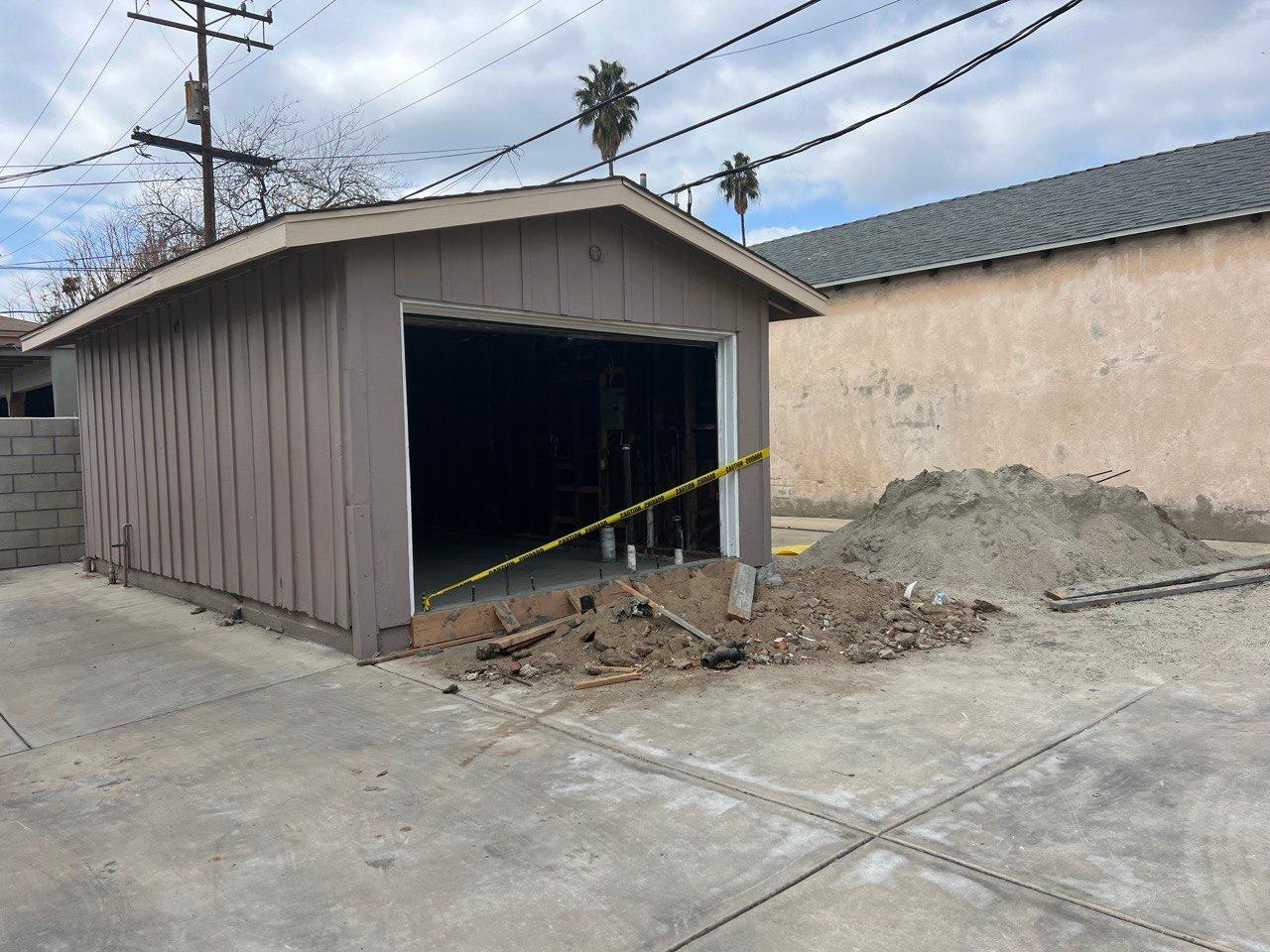
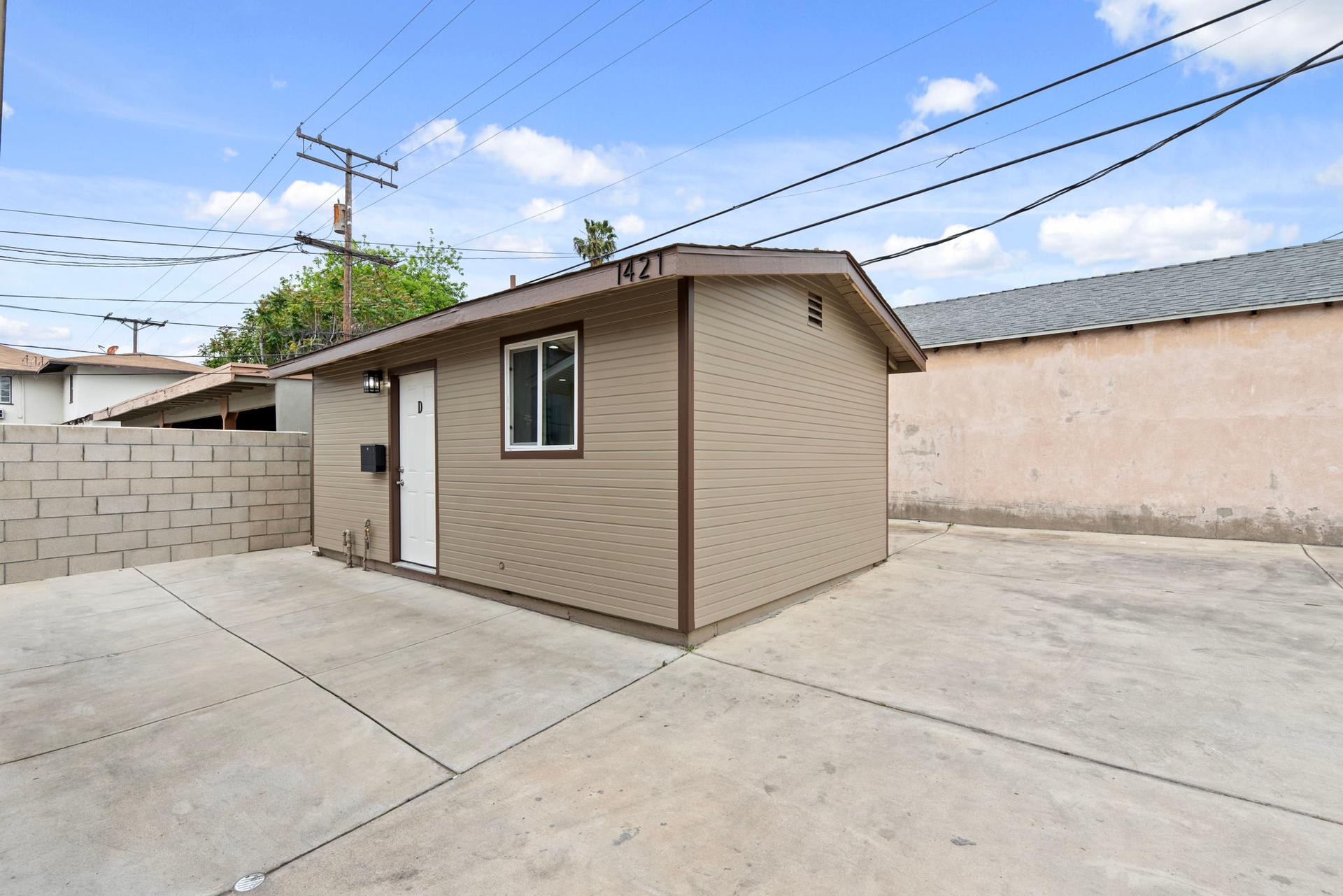
Our Tustin job started as a detached one-car garage with no insulation, no dedicated electrical panel and no plumbing for a kitchen or bathroom. We took it down to the studs and rebuilt it with new insulation, a dedicated electrical panel, and supply and drain lines for a kitchenette and a bathroom. The studio has a quartz and subway tile kitchenette with a gas range, a glass-enclosed shower, in-unit laundry, luxury vinyl plank flooring and a ductless mini-split. It took two to three months, is fully permitted and has its own address.
Read the Tustin garage-to-ADU case study for the full scope and photos, or our guide to garage-to-ADU conversions in Orange County for the state rules in detail. In Newport Beach, the city's own size, parking and Coastal Zone rules are in our Newport Beach ADU guide.
General information, not legal advice. State law is cited as of November 2026, and city rules change, so confirm current requirements with your city's planning department before design starts.
What to expect
How your remodel moves from first call to finish

Building an ADU or addition means coordinating permits, inspections, and several trades. Learn how we run that as your general contractor in Orange County.
Service area
Residential construction across Orange County
Licensed in California (CSLB 1021647), based in Fountain Valley. We take new residential construction projects throughout all of Orange County.
Financing available
Break your ADU or addition into monthly payments
Prequalify through Acorn Finance in minutes, with no impact to your credit score. Compare offers from a network of lenders, then choose what fits your budget.
Common questions
Residential construction FAQ
Do you build ADUs in Orange County?
Yes. ADU and garage conversion projects are a regular part of our residential construction work, alongside room additions and whole-home renovations. ADU rules such as setback distances, maximum size, parking requirements, and utility connections vary by city even though California state law sets a baseline that applies statewide, so we start with an on-site visit to confirm your lot's specific zoning and what your city will actually approve, rather than assuming a standard layout will work everywhere. That visit also covers practical site questions: where utilities currently run, whether the existing electrical panel has capacity for a second unit, and what access looks like for construction equipment and material deliveries. From there we put together a written scope covering design, permitting, and construction phases so you know what to expect at each stage before committing to the project.
Can CRS manage a project that includes kitchen, bath, and addition work?
Yes, and combining a remodel with added square footage is actually a common way homeowners approach a larger renovation, since permits and disruption to the home overlap regardless of whether the work happens in phases or all at once. We sequence these projects carefully: structural work and the building shell come first, followed by rough plumbing, electrical, and HVAC that has to be in place before walls close up, then the kitchen and bath finish work layers in once the addition is weathertight. Keeping all of this under one contractor means inspections, subcontractor scheduling, and material lead times stay coordinated on a single timeline instead of you managing separate crews and separate permits for each piece. We build the written scope to reflect the full combined project from the start, rather than pricing each piece in isolation.
Who pulls permits for residential construction?
CRS Construction pulls permits whenever your scope requires city approval, which covers nearly every addition, ADU, or structural project. We prepare the plans or coordinate with your architect or engineer, submit the application to your city's building department, and track it through plan check and approval. Once work begins, we schedule inspections at the required stages (foundation, framing, rough mechanical, and final), and we don't close up walls or pour concrete until each required check has passed. This matters for two reasons: it's how the city confirms the structural, electrical, and plumbing work actually meets code before it's hidden behind drywall or under a slab, and it protects you if you ever sell the home, since unpermitted structural work is one of the more common issues that surfaces during a buyer's inspection or appraisal.
How do residential quotes differ from kitchen or bath-only jobs?
Larger residential projects carry more upfront planning than a kitchen or bath remodel, because there's more that can go wrong if it's assumed rather than confirmed. Before we put together a scope, we look at structural questions, soil conditions if a new foundation is involved, utility capacity for the added square footage, and any city or HOA approval that applies to your specific property. We put together a written estimate after an on-site visit rather than a phone quote, and for projects with multiple stages, such as a foundation and shell phase followed by interior finish work, we'll often price it in phases so you can see costs and decision points along the way instead of one lump number covering months of work with unknowns baked in.
Which areas do you serve for ADUs and additions?
We serve all of Orange County from our Fountain Valley office, including Irvine, Huntington Beach, Newport Beach, and the surrounding cities. Larger residential projects like ADUs and additions benefit even more from local knowledge than a kitchen or bath remodel does, since zoning, setback rules, and permit timelines vary by city and directly shape what's actually buildable on a given lot. Working from a central Orange County base means we're already familiar with the permit offices and typical review timelines in the cities we build in most often, which helps set realistic expectations for how long design approval will take before construction can start. If you're outside this immediate list of cities but still in Orange County, it's worth reaching out directly. Our service area is built around the county broadly, not a fixed set of names.
Does an ADU need a separate utility connection?
It depends on your city and utility provider, and this is one of the details that varies the most from one jurisdiction to the next. Some cities and utilities allow an ADU to share the main home's water and electrical service through a submeter, which is typically simpler and less expensive than a fully separate connection. Others require a completely independent utility connection for the ADU, especially for larger detached units or when the main home's existing electrical panel doesn't have capacity for the additional load. Sewer and gas connections have their own city-specific rules as well. We research what your specific city and utility provider require as part of the planning phase, before the design is finalized, since this decision affects both the project budget and where the ADU can practically be sited on your lot.
How long does ADU permit approval take?
California state law requires many cities to process complete, code-compliant ADU applications on an expedited timeline compared to standard discretionary permits, which is meant to make adding an ADU faster and more predictable than it used to be. That said, actual turnaround still depends heavily on your specific city's current workload, whether your submitted plans are complete and meet code on the first pass, and whether any revisions are requested during plan check. We handle the full submission and respond to city comments as quickly as they come in, since delays at this stage are often about how fast plan-check corrections get answered, not just how busy the city is. We'll give you a realistic estimate for your specific city once we know its typical turnaround, rather than quoting a generic number that may not reflect how your jurisdiction actually operates.
How much does it cost to build an ADU in Orange County?
Most Orange County ADU projects fall between roughly $150,000 and $300,000 for a new detached unit, $50,000 to $150,000 for a garage conversion, and $120,000 to $250,000 for an attached, addition-style dwelling, with cost per square foot generally landing between $250 and $450 depending on size, finish level, and site conditions. Sloped lots, difficult equipment access, long utility runs, and premium finishes all push a project toward the higher end. Because those site factors vary so much from one property to the next, the only way to get a real number is an on-site visit and a written scope. Our ADU cost guide walks through the price drivers in detail so you can plan a budget before we ever meet.
Does an ADU increase property value in Orange County?
In most cases, yes. A permitted, well-built ADU is generally viewed favorably by appraisers and buyers because it adds legitimate, independently livable square footage and, in a strong rental market like Orange County, real rental income potential. The two returns work together: the ongoing rental income can help offset the build cost while you own the home, and the added value shows up again at resale. The key word is permitted. An unpermitted unit can actually complicate a sale, since it tends to surface during a buyer's inspection or appraisal, which is one more reason we pull the proper permits and pass every required inspection rather than cutting corners on approval.
Is the $40,000 California ADU grant still available?
Not right now. The CalHFA ADU Grant Program, which reimbursed up to $40,000 of pre-development and closing costs, fully allocated its funding at the end of 2023 and is not currently accepting new applications. The state legislature has periodically reauthorized partial funding, and CalHFA has reopened the application window in waves when new money arrives, so it may return, but as of now there is no open round. CalHFA also warns homeowners that anyone claiming they can still secure the grant may be running a scam, so verify any grant claim directly with CalHFA or an approved lender. We don't administer the grant, but we're happy to build your ADU on a timeline that keeps you ready to apply if a new funding round opens.
Further reading
ADU guides
Planning, budgets, and material choices before you hire a contractor.
Get a residential construction quote
Tell us about your ADU, addition, or whole-home scope. We will follow up to schedule a site visit and written estimate.